
149 minutes of interview to Enzo. Castellari in the program of radio Sunset Boulevard in Artegalia

Year: 1973
Country: Italy
100 min.
It photographs: Alejandro Ulloa
Music: Guido and Maurizio De Angelis
Script: Enzo G. Castellari, Gianfranco Clerici, Vincenzo Mannino and Leonardo Martín
I distribute: Franco Nero, James Whitmore, Delia Boccardo, Fernando Rey, Duilio Del Prete, Silvano Tranquilli, Ely Galleani The police detains, the law judges still it is near to the subject-matter and the spirit of the spaghetti-denunciation that Damiano Damiani was inaugurating with Confessions of a commissioner in 1971, a political movies that was using the popular force of the genre, his codes and his esthetic rudeness. Castellari contributes then one of the seminal qualifications of the current, personalized with his frantic habitual style, replete with camera in hand and assembly to blows with an axe. 

The history perspires an undeniable realism born of the capacity (quite it demagogic that loves) to translate in images and drives the pathos of the Italian society of the epoch. That is to say that the authenticity of this movie does not meet only in his urgent cinematic form in the sensational use of the Genoese, perfect geography his complicated paved streets ready for the frantic pursuits and the round action to the rhythm of Guido and Maurizio De Angelis, but in this primary dramatic, so schematic heart, amarillista and tremendista as it seems, the everlasting history of the complete man faced top forces, dark governmental powers that prevent from coming to the
Beyond this capacity, with complete certainty unpremeditated or born of a will purely economic of aprovecahmiento of a sociological phenomenon that it had to the violence and to the fear in his epicenter, the history is complicated and more confused than dense, to what it is necessary to add that the political criticism never overcomes the thick line. But this way the bases of the poliziottesco setentero have just sat down. A few characteristics to which it is necessary to add the character (or to remain because it does not stop being a problem) derivative of the whole invention, a cheeky exploit (of course, re-turned quickly into a typically Italian product by means of insuflar a non-transferable screaming personality and a charismatic horterez) of The French Connection of William Friedkin (why
In any case a movie to be born in mind, so much if the same (it is entertained and shining, it never loses the rhythm and gives everything who promises) as for being this reflex in dirty of the Italian reality from the perspective of a knowing popular movies of that “the message” (although it is ambiguous and slippery) strains better with fireworks, careers, shots and nudes.

Castellari directing big secondary James Withmore during the shooting of The police detains, the law judges
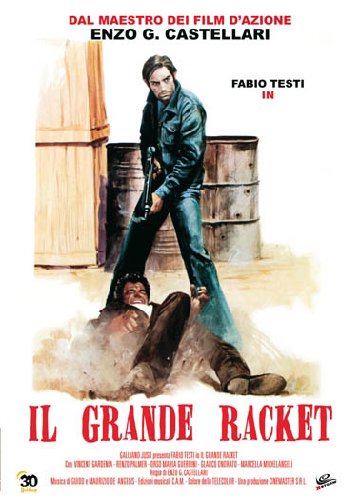
Year: 1976
Country: Italy
104 min.
It photographs: Marcello Masciocchi
Music: Guido and Maurizio De Angelis
Script: Enzo G. Castellari, Massimo De Rita y Arduino Maiuri
I distribute: Fabio Testi, Vincent Gardenia, Renzo Palmer, Orso Maria Guerrini, Glaucous Onorato, Marcella Michelangeli, Romano Puppo
Big Il racket or Outlaws 77, is an already very different thing. At this point the political component was so diluted and one had turned in so extremely demagogic that it looks like already a caricature. The social intentions have happened to be one more coloristic layer (that in case earlier they it were not also, although not in such a clumsy way), ideology slides for suspicious slopes and what stays in this copy of the “second age of the eurocrime” is a disfrutable
Certainly Castellari was never a thin stylist but he always managed them to leave unforgettable moments in his taste for the impossible framings (included his fixation in spite of fitting across circles: tubes, holes, …) and the esthetics between stylish and brutota that here is a fantastic sample in the pompous scene in which, the car of Fabio Testi, with Fabio Testi inside, is thrown by a terrace turning. All this filmed from within, with camera and actor subject to the seats and reproduced to “super-slow motion“ with an effect alucinatorio of pendent time and floating glazing (is not going to believe Guy Ritchie or Zack Snyder who have invented anything). 


This way the final third supposes a long climax of primary action where the hero recruits to a mixed number of harmed (a veteran pickpocket whom the excellent secondary North American Vincent Gardenia interprets, a mafiosote fallen from grace and forced to take a metallic corset, a professional killer now between grills, the father of a violated and murdered young woman turned into a psychopath and an Olympian shooter whose woman was humiliated and burned because he helped the police during an affray). A particularly brutal scene that certifies the enormous increase of the graphic violence and progressive brutalización that esclerotizó, not only to the poliziotteschi, but to the whole movie theater encore) for the villains to face them in a desperate action, taking the justice where the law does not come, in a definitive showdown full
Certainly it is not at a height of more elaborated works as The police stop, the law judges or even the later one The route of the drug (1977), but it is a craft to complete letter, a work of professional who does not cheat anybody and gives all that he announces: action in abundance, music fardona, populism and lead for the villains.
Milan odia:la polizia odd puo sparare
Rome to hand armata
Filed bajo:70's, action, Enzo G. Castallari, Eurocrime, Union of craftsmen, big Il racket (Outlaws 77), Italy, The police detains the law judges, Thriller Tagged: 70's, action, craftsman, murder, big racket, movie theater encore, city, commissioner say to the Italian that it ironed, crime, degardación, Enzo G. Castellari, Eurocrime, Fabio Testi, Forajo, Franco Nero, genres, gone 77, big Il racket, The police detains the law judges, pursuits, poliziottesco, blood, sex, sordidness, spaghetti-denunciation, Thriller, shots, revenge, violation, violence

No comments:
Post a Comment