Thursday, March 18, 2010

Beretta 70: The police stop, the law juzga/Il big racket, the poliziottesco as Enzo G. Castellari. Action, politics and sensationalist journalism, the ages of the genre

I return to the poliziottesco chemically purely across one of his more emperrados cultivators, this stonecutter of the camerawoman that was Enzo G. Castellari pillar of an industry (it bore even the most third-world years of the dirt post-apocalítica) supported by the hormigueante activity of the popular movies of the age of the joint productions. A hyperproductive, shameless substratum, intermitentemente brilliant and immodestly money-grubbing that allowed, not only the existence of an unforgettable epoch for the genre but the possibility of the splendor autoral during more than two decades in general Europe and in the Italy of the “economic miracle” in particular. So a memory and a gratitude for the services given across this double meeting that rescues two works of his in the territories of the police action (along with the spaghetti-western - that one abstract, symbolic and medievalizante frenzy that was Keoma in 1976, for example - the place where it left his the best effort) with The police stops the law judges and big Il racket, movies that represent the shining splendor and degradation of the transalpine police movies, from the frantic denunciation to the action donkey in only three years. And it is that encore” an intensive time lives through the “movie theater.

149 minutes of interview to Enzo. Castellari in the program of radio Sunset Boulevard in Artegalia

The police stop, the law judges (The polizia accuses the legge assolve)

Year: 1973

Country: Italy

100 min.

It photographs: Alejandro Ulloa

Music: Guido and Maurizio De Angelis

Script: Enzo G. Castellari, Gianfranco Clerici, Vincenzo Mannino and Leonardo Martín

I distribute: Franco Nero, James Whitmore, Delia Boccardo, Fernando Rey, Duilio Del Prete, Silvano Tranquilli, Ely Galleani The police detains, the law judges still it is near to the subject-matter and the spirit of the spaghetti-denunciation that Damiano Damiani was inaugurating with Confessions of a commissioner in 1971, a political movies that was using the popular force of the genre, his codes and his esthetic rudeness. Castellari contributes then one of the seminal qualifications of the current, personalized with his frantic habitual style, replete with camera in hand and assembly to blows with an axe.

The history perspires an undeniable realism born of the capacity (quite it demagogic that loves) to translate in images and drives the pathos of the Italian society of the epoch. That is to say that the authenticity of this movie does not meet only in his urgent cinematic form in the sensational use of the Genoese, perfect geography his complicated paved streets ready for the frantic pursuits and the round action to the rhythm of Guido and Maurizio De Angelis, but in this primary dramatic, so schematic heart, amarillista and tremendista as it seems, the everlasting history of the complete man faced top forces, dark governmental powers that prevent from coming to the truth. Role that relapses on a Franco Nero turned already into inseparable presence of the sub-genre, always sufridora but inflexible double embodiment, on the one hand the average citizen faced the axes of the corrupt "System", for other this figure of “commissioner I gave it ironed” like last safe-conduct, an archetype that Maurizio Merli would take up to his grotesque entire reduction and that here is humanized by his devotion towards his daughter.

Beyond this capacity, with complete certainty unpremeditated or born of a will purely economic of aprovecahmiento of a sociological phenomenon that it had to the violence and to the fear in his epicenter, the history is complicated and more confused than dense, to what it is necessary to add that the political criticism never overcomes the thick line. But this way the bases of the poliziottesco setentero have just sat down. A few characteristics to which it is necessary to add the character (or to remain because it does not stop being a problem) derivative of the whole invention, a cheeky exploit (of course, re-turned quickly into a typically Italian product by means of insuflar a non-transferable screaming personality and a charismatic horterez) of The French Connection of William Friedkin (why of the pursuits, in this one and in others, also it is there) that even appeals Fernando Rey so that again he dresses himself of elegant and sibylline criminal, in this case a veteran I geld the one that the young generations try to withdraw and that will help interesadamente the commissioner protagonist.

In any case a movie to be born in mind, so much if the same (it is entertained and shining, it never loses the rhythm and gives everything who promises) as for being this reflex in dirty of the Italian reality from the perspective of a knowing popular movies of that “the message” (although it is ambiguous and slippery) strains better with fireworks, careers, shots and nudes.

Castellari directing big secondary James Withmore during the shooting of The police detains, the law judges
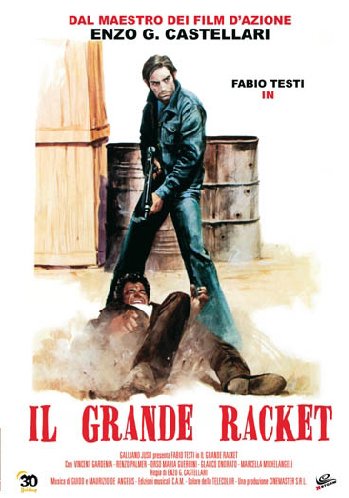
Big Il racket (Outlaws 77)

Year: 1976

Country: Italy

104 min.

It photographs: Marcello Masciocchi

Music: Guido and Maurizio De Angelis

Script: Enzo G. Castellari, Massimo De Rita y Arduino Maiuri

I distribute: Fabio Testi, Vincent Gardenia, Renzo Palmer, Orso Maria Guerrini, Glaucous Onorato, Marcella Michelangeli, Romano Puppo

Big Il racket or Outlaws 77, is an already very different thing. At this point the political component was so diluted and one had turned in so extremely demagogic that it looks like already a caricature. The social intentions have happened to be one more coloristic layer (that in case earlier they it were not also, although not in such a clumsy way), ideology slides for suspicious slopes and what stays in this copy of the “second age of the eurocrime” is a disfrutable ration of action without complications.

Certainly Castellari was never a thin stylist but he always managed them to leave unforgettable moments in his taste for the impossible framings (included his fixation in spite of fitting across circles: tubes, holes, …) and the esthetics between stylish and brutota that here is a fantastic sample in the pompous scene in which, the car of Fabio Testi, with Fabio Testi inside, is thrown by a terrace turning. All this filmed from within, with camera and actor subject to the seats and reproduced to “super-slow motion“ with an effect alucinatorio of pendent time and floating glazing (is not going to believe Guy Ritchie or Zack Snyder who have invented anything).

The history does not give for very much and this archivist (inflexible police officer and of slightly orthodox methods, if Harry the dirty one is another key movie in the sub-genre as it is not difficult to foresee, faced to a savage gang whose advances are constantly obstructed from "above"), but the director in a curious feature that looks like a responsibility, he manages them to derive it towards one of his favorite areas: the heterogeneous group assembled by the force of the circumstance and forced to collaborate. Favorite topic of Castellari treated with many fortune in qualifications as the marvelous eurowestern Kill them and turn (1969) led by Chuck “The man of the rifle” Connors or now very famously That damned armored train of 77 (whose kinship with the Damned Bastards tarantinianos does not go beyond the wink to his title anglo and a pair of cochairs here or there, however much many unoccupied juntaletras has been in charge of proclaiming it to voices like a literal remake and not like an inspiration / wink / homage), one of scarcely qualifications salvables (of shameless and bad-tempered cigar) of between the little fish of the Nazi - western (or spaghetti-war, as it is preferred).

This way the final third supposes a long climax of primary action where the hero recruits to a mixed number of harmed (a veteran pickpocket whom the excellent secondary North American Vincent Gardenia interprets, a mafiosote fallen from grace and forced to take a metallic corset, a professional killer now between grills, the father of a violated and murdered young woman turned into a psychopath and an Olympian shooter whose woman was humiliated and burned because he helped the police during an affray). A particularly brutal scene that certifies the enormous increase of the graphic violence and progressive brutalización that esclerotizó, not only to the poliziotteschi, but to the whole movie theater encore) for the villains to face them in a desperate action, taking the justice where the law does not come, in a definitive showdown full of slow camera and impacts in the first plane that does not give truce and almost influential John Woo prefigures the eternal shootings of the heroic-bloodshell hongkones become fashionable for, in times.

Certainly it is not at a height of more elaborated works as The police stop, the law judges or even the later one The route of the drug (1977), but it is a craft to complete letter, a work of professional who does not cheat anybody and gives all that he announces: action in abundance, music fardona, populism and lead for the villains. Milan trembles the police asks for justice

Milan odia:la polizia odd puo sparare

Rome to hand armata


Filed bajo:70's, action, Enzo G. Castallari, Eurocrime, Union of craftsmen, big Il racket (Outlaws 77), Italy, The police detains the law judges, Thriller Tagged: 70's, action, craftsman, murder, big racket, movie theater encore, city, commissioner say to the Italian that it ironed, crime, degardación, Enzo G. Castellari, Eurocrime, Fabio Testi, Forajo, Franco Nero, genres, gone 77, big Il racket, The police detains the law judges, pursuits, poliziottesco, blood, sex, sordidness, spaghetti-denunciation, Thriller, shots, revenge, violation, violence

Wednesday, March 17, 2010

“This is his life”: Profesionalac, a Balkan comedy. The word and the work of Dusan Kovacevic, satire, tenderness and Yugoslavian history

Profesionalac supposed, in 2003, the return to the direction of the big playwright and scriptwriter (in addition to political activist) Dusan Kovacevic more than twenty years after the outstanding figure The spy of the Balkans (commented here). In this occasion already alone and again adapting a proper stage play of the year 1990 (certainly edited in Spain for Bow in 2005 with translation of another playwright, the Catalan Jordi Galcerán) so successful as the majority of the work of the author, threatening wise person of the sociopolitical sulfide, the comedy of local customs and manners / crazy and the virguerías simbólicas/metalingüisticas. It never obviated, always sophisticated, worried because the "message", the "thesis" do not eat the diversion or of that this one is exclusively to his service. Leaving that the criticism against the system usually takes the form of a farce, sometimes smiling, sometimes sad, always melancholic and a point macabre. As if his texts wanted to bottle a way of being, a concept of “the Serbian thing” that venerates equally the fatalism and the jollification, the resignation and the mockery. A lucidity that comes straight from the organic knowledge of the defeat.

Dusan Kovacevic (left) directing Bora Todorovic

It would be extraordinarily arid to start shelling here the work as Kovacevic's scriptwriter (down whose auspices have rolled, Slobodan Sijan, Goran Paskaljevic, Goran Markovic or Emir Kusturica), so I was enough to say that without his contest the Yugoslavian movies from the 80 even the actuality would be completely different. From the rough choral comedies (Ko to fluff peva, 1980), up to the historicist review (Maratonci trce pocasni krug in 1982, Underground in 1995 or in another tone his recientísimo script for luxurious Sveti Georgije ubiva azdahu already in 2009), happening for the underground and ridiculous criticism of the communism and the post-titismo (Poseban tretman in 1980 or already mentioned Balkanski spijun en1984) or the sensibility near to the magic realism (a big tradition Balkan and Russian, certainly, not always is necessary to assume it to the “Latin-American boom”) of beautiful Sabirni Centar (1989), a singular fable on the persistence of the memory and the double nature of the death, the physics and that of the memory. In any case an indispensable personality and a curious case of indirect responsibility, since Kovacevic's style in the drama and the text, his extraordinary clairvoyance and his tenderness are imposed on almost (perhaps Kusturica has been the exception in some aspects, although in fact he is influenced himself by Kovacevic of the primerísimos 80) any director, up to the point of being able to affirm that a movie written by Dusan Kovacevic is a movie of Dusan Kovacevic. And now if, now Profesionalac. This work, an enormous victory on the stages, (this is an unusual peculiarity of the author: it is a figure permanently critical and challenging but paradoxically popular and ticker clerk, an extraordinary tightrope walker between the awkward thing and the mainstream) had already known a television adaptation in 1990 with two major glories of the Yugoslavian performance like Danilo “Robe“ Stojkovic and disarming Bogdan Diklic (one of the actors the most talented that I have seen in my life) like the secret police and the ancient dissident whom he watched for years.

Kovacevic recovers a work, which curiously it precedes (and it can turn like a variant for better) in not few thematic aspects to a bloodless jumble as The life of others (2005), perfect example of European qualitè all dressed up that inflates a good idea by means of pretentiousness transcendentalista, false depth and domesticated esthetics of luxurious series. And opposite to so much dramatism without real drama, this black comedy (genre indisociable of the Balkan movies) acclimates the original to the contemporary Serbia placing two times of the history at present and in the Yugoslavia in full destruction during the 90s (essential in this sense the understudy The Balkan pitfall of F rancisco Veiga published by Grijalbo in 1994 and checked in 2002), a change that only benefits to the potency the speech and to multiply the impact of his sardonic end lampedusiano.

Unfortunately the movie if it suffers on one hand from the permanent problem in Kovacevic's scripts, this is, his excessively theatrical mechanics (here partially hidden by the constants flashbacks that they air the plot limited scarcely to a room), and for other one of a quite flat, scarce staging in resources purely cinematographic and definitely functional. A disadvantage staunched partially by the virtues merely “esthetic“ of the words and by the conceptual force, the historical sagacity and the comical panache. Namely Kovacevic is not the good director, but he is a man with ideas and aptitude to count, with an overwhelming office and genuine talent, a combination that serves to him to go out more than airy of the attempt and to end up delivering a movie replete with virtues, which see to simple sight and someone more intangible and cardinal others.

This way the personages' duel in the only stage of the office, ventilated with these constant jumps to the past, is complemented, in one of these typical metaphorical operations of the author (something that works like mirror of the principal history, a teatralización that is a work inside the work and that comments / complements on this central incident to “to put it in scene”), for the strike that develops in the publishing house (and that is commanded by a violent ex-informer and killer of the police) that the personage of Branislav Lecic directs: Teodor Teja Kraj an ancient political leader against Milosevic, frustrated writer and refixed university teacher in businessman who has forgotten the idealism for the pragmatism. A personage that, one day receives the visit of a little man, Luka Laban chief of the police of the ancient diet, which delivers to him a few books and a suitcase that contains literally his past, a life compiled by the one who was in charge of watching him.

The movie is supported in one double of principal personages marvelous but a point unbalanced in favor of the memorable commissioner that Bora Todorovic composes with his habitual economy of means and his elaborate comical "timming" based precisely on the containment gestual, here also enriched by the proper physical decline of the actor, what promotes even more his habitual given up and melancholic gesture. But although it is true that Lecic does not stop giving the size like partenaire and that he is a somewhat rigid actor, his presence (instead of the same Diklic, for example) he answers to a different will. And the fact is that the actor interprets here a change if the same, and the documentary inserts of the movie are therefore real, testimony of his mítines and activities when the Pli was leading ell revolucija (and in one of them it can turns to proper Kovacevic, intervening from the real past in the movie that directs from the present), therefore personage and actor blurs his limits for refundirse in the only one and they provide to the movie and to the personage of a different dimension, near to the autofiction. A risky approach that not only uses the habitual metafiction in Kovacevic but it introduces reality records in simulation territories. Submitting the narrated to a collision against the real thing, turning the confrontation between personages into a personal exorcism. An immersion in the immediate past of a country and of a generation across the "dramatized", stylized version, of one of them like symbol of the rest.
But this subtext, this double level, is always supported to streak by the direction and the writing, in such a way that I did not go on to the first plane, but it is supported like enriching element and not like only one. Kovacevic shows then his brilliant handling of the gag, with special mention to his intelligent use of “an appellant” (the friend always descalabrado, the blonde who appears by spell …) and in his absence of prejudices to resort to the vodevil: But especially the movie counts with one cardinal wise move: to begin everything in a completely serious way and a threatening point to turn it then progressively absurdly (an exercise of paranoia splendidly achieved also in The spy of the Balkans, where the laugh is born of the fear) doing that the comicalness works for contrast.

The hunting and alertness on Tile is opened like a species of thriller that mixes reporteril reconstruction and abstraction kafkiana and is transforming per moments in its own parody (what into certain way turns it in even more terrifying) with this commissioner appearing with his mortadelianos disguise in all the moments of the life of the protagonist (brilliant the detail of the different mustache every time or that of the musicians run aground in the same one according to recognizing it during his first appearance like improbable newspapers seller in the bar where the protagonist meets his friends) and determining the direction of the same one, first trying to kill it and then saving it on having discovered it in love with his own daughter, without we happening to discern which is two attempts more stupid and off balance. This way every operation is more ridiculous and more delirious (deifying the deployment of police officers disguised as Santa Claus and descacharrante the moment in which it takes in arm the protagonist after falling down of a train in march) in a climb that thinks about how to undress the idiotic absurd cigar of a system frenzied and rotted up to the core.

A movie that it improves rested and that supposes a vital and personal trip for the recent history of Serbia during a decade in whom the hell one installed in the heart of Europe without it seeming to nobody to import big thing for him. A sinister walk along the spied and manipulated memory of the hand of a man who reconstructs his life of the hand of someone who, from the shade, knows it better than.

Profesionalac (The Professional)

The director: Dusan Kovacevic

Year: 2003

Country: Serbia

104 min.

It photographs: Bozidar 'Blunt' Nikolic

Music: Momcilo ‘Bajaga‘ Bajagic

Script: Dusan Kovacevic

I distribute: Bora Todorovic, Branislav Lecic, Natasa Ninkovic, Dragan Jovanovic, Josif Tatic, Miodrag Krstovic, Renata Ulmanski, Milos Stojanovic, Sergej Trifunovic


Filed bajo:00's, Balkageddon, comedy, Dusan Kovacevic, Historical, I Spy, Profesionalac, Serbia Tagged: autofiction, balcanes, Belgrade, Bora Todorovic, Branislav Lecic, comedy, Dusan Kovacevic, war, history, black humor, manipulation, musical, metatextual, Milosevic, paranoia, politics, police officer, Profesionalac, reality - fiction, Satire, Serbia, catastrophe, tatro, alertness

Tuesday, March 16, 2010

“They hommes between eux”: The day of the anger. Tonino Valerii, learning and reflection between the eurowestern and the American classicism.

The day of the anger (I Giorni dell'ira)

The director: Tonino Valerii

Year: 1967

Country: Italy / Germany

112 min.

It photographs: Enzo Serafin

Music: Riz Ortolani

Script: Ernesto Gastaldi, Renzo Genta y Tonino Valerii as the novel of Ron Barker Der Tod Ritt Diemstags (?)

I distribute: Lee Van Cleef, Giuliano Gemma, Walter Rilla, Christa Linder, Ennio Balbo, Lukas Ammann, Andrea Bosic, Pepe Calvo, Giorgio Gargiullo, Anna Orso

A truly extraordinary movie and one of the best spaghetti-western produced in the whole Europe, which supposes the masterpiece of Tonino Valerii (already claimed here with his curious twilight and autoconscious eurowestern My name is none and with an onlooker giallo like bloody Summary of the kidling Estefanía, a movie which personality is born of the contrast between the moral sordidness of fund and the polished cinematic form that he adopts), the personal director (and ignored) like few ones during the epoch and perhaps the one that more has felt Leone's weight like legend (of which also it was collaborating) despite being who more conscious effort realized to become alienated from his aegis. (Here an interview to Valerii and to the excellent critic and historian Roberto Curti)

On an excellent script, the paternal - subsidiary history between a young despised and maladjusted bastard and a cold gunman who him will take under his protection while it dominates a small village by means of lead and fear, Valerii applies his absolutely intimate conception of the movies of genre (shared with an aprpar of Spanish authors: Joaquín Romero-Marchent and Eugenio Martín) across an elegant planning and a narrative and “clear line”, triumphing after the North American outstanding figures being sent principally (especially magnificent outlaws' Hunter-1957 - of Anthony Mann although with different dramatic sense and to the "psychological" school in particular, even with similarities italianizadas with the monumental novel of Oakley Hall, Warlock, mediocremente adapted / simplify for Edward Dmytryk in The man of the golden guns, 1959) and without limiting itself to exploiting the lode way Leone seguidista.

And it does it up to the point of which The day of the anger is content like a big western to dry seasons, without surnames, which of not belonging to a moment and a few so particular coordinates would be considered to be a summit, for conceptual thickness, moral depth and reflective keenness.

Also Valerii does not also despise the styling and the excess in the characterization (debtor of the series - b, the tebeo and the pulp as perfect examples of expressive economy of means) proper of the movies of Italian genre, intelligently used in details like the mythical character (of which also a conscious and deep analysis is tackled) in the proper personage of the hitman (delightfully delirious duels, for example that one that develops on horseback as if it was a medieval joust) or in this gun belonging to Doc Holliday that the boy as the only heredity hoards and that reflects the importance icónica of the objects as components of one imaginary essential ritual in the universe of the eurowestern.

But the movie would not go on from a modest attempt if everything was entrusting it to the plot (minimal and schematic), the real power of this work resides in his sensational personages protagonists, both very well interpreted by an absolutely stellar duo: Giuliano Gemma leaving of his archetype, a species of always smiling, athletic and positive Mediterranean Burt Lancaster that it tested for the festive qualifications in which Duccio Tesari tried to offer a festive alternative and innocently unpolluted to the dirt and the brutalización of the genre. Gemma, in his best interpretation, is battered boy, that it has not even surname (he will be Frank Talby who baptizes it, ungiéndolo this way of manliness and dignity for the first time) and whom the whole world there abuses, progressively turned into a feverish gunman for the power of the weapon and for the influence of his teacher, one Lee Van Cleef who controls the movie with his imperturbable and merciless freightage of hawk (simply unforgettable, so much like his "Colonel Mortimer" of The death it had a price, which already that is to say).

It is this relation of teacher / pupil, of father / son, so typical of the western on the other hand, which it provides to the movie of all his complexity (and of a lyricism to which the anthological score of Riz Ortolani is not foreign), on having established about the same one a series of ideas and reflections, I half-close to the violence and his use, the power, the dichotomy law / justice (or rather “who“ applies it) and the disappointment, with the component of ripeness and evolution that this implies (and quite without pretentiousness none). A trip of learning and construction of the personality designed cinematográficamente in such a way that the raised during his first one half-closed the personages and the fascinated vision that of Talby there has Scott (and with him we, the spectators that we inform permanently of his subjective perception), it is dismantled systematically during the second one, in which, simultaneously, Gemma's personage transforms in the naked and grotesque portrait of that of Van Cleef and finally he realizes, having been recognized after if the same and his teacher in this real image without idealizing, of where it has come and of that in his hand is to finish it. Although it will have to be, paradoxically, for a final act of violence in which it will have to apply all the learned lessons. Up to the last one and cruelly.


Filed bajo:60's, The day of the anger, Eurowestern, craftsmen's Union, Italy, Politique give auteurs, Tonino Valerii Tagged: to the Italian, pupil, learning, killer, bullets, bastard, classicism, duel, The day of the anger, Eurowestern, Giuiliano Gemma, José Calvo, lesson, Lee Van Cleef, maturation, teacher, to kill, paternofilial, gunman, spaghetti-western, shooting, Tonino Valerii, violence